
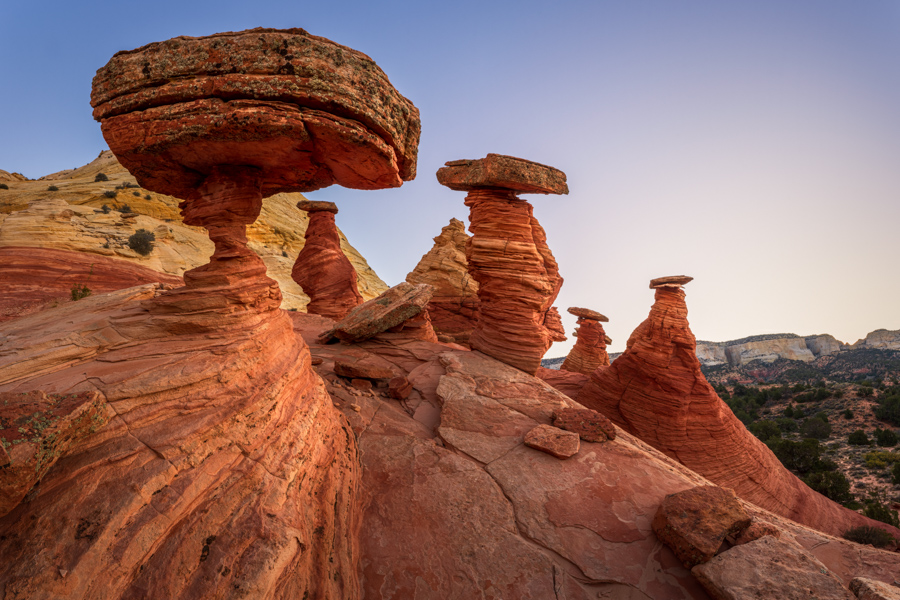

Because of their nature, the number of grand landscape possibilities is seemingly limited. The world can only be filled with so many unique views, right?
Many new photographers associate grand landscapes with iconic places like the Maroon Bells, Mesa Arch, Cannon Beach, etc. Iconic locations are iconic for a reason. There’s nothing wrong with taking these iconic shots, but in doing so, you’re sacrificing creativity.
When photographing these grand scenes, it can sometimes feel like you’re not doing anything new, and that creativity takes a back seat. This is why many photographers, over time, migrate to photographing smaller scenes.
As someone who LOVES the grand landscape, I strive to continue photographing these grand landscapes without sacrificing creativity. My hopes with this presentation is to inspire YOU to go out and explore and create your own unique grand landscape photographs.
First though, What Is A Grand Landscape?
- This is what comes to mind when someone thinks of Landscape Photography.
- Defined by sweeping vistas, epic views and dramatic scenery.
- Usually, but not always, taken with a wide angle lens.
- Generally follows the formula of having a foreground, mid ground and background.
- Often taken during sunrise / sunset.
1: Creativity at Iconic locations.
Just because a subject has been photographed before, doesn’t mean you can’t be creative with it.
Think about how a location would look from a different perspective and ask yourself these questions: What would it look like at different focal lengths? What would it look like from a different angle? How would the view change if I climbed this hill?
Be Inquisitive! Wander. Climb. Get low.
Don’t settle for the same photo everyone else is taking.


- Just because everyone is shooting from one vantage point, doesn’t mean they have the best spot. It might be a tried and true location, but it’s going to be difficult to differentiate among the thousands of shots taken there by other photographers.
- It’s tempting to go back to the classic spots because it’s guaranteed. Be okay with NOT getting a shot. Sometimes exploration pays off and sometimes it doesn’t.
- Don’t stop asking questions. Curiosity leads to discovery.
- It doesn’t take a full on expedition to find a new angle or composition. Sometimes, all it takes is a short hike to get an entirely new view and composition. Wander around. Explore. You’ll be surprised by what you find.
2: Creativity in NEW locations
Travel! This is the driving force behind many of our photography pursuits. To see what is out there. To document that, and to create art from where we’ve been and what we saw.
In landscape photography, this means traveling to new, beautiful locations. Sometimes this is to a neighboring state, and sometimes another continent.
New locations give you the opportunity to capture grand landscapes where you don’t have pre conceived ideas about an iconic view or what something “should” look like. This gives you an opportunity to not just take images, but CREATE them.
- It’s sometimes unrealistic to plan an entire vacation around exploration, with no guarantee of getting a good shot. Instead, I like to build “explore time” into my travels, where I visit a location that I’ve never seen a photo of.
- This takes time and research, but going somewhere completely unknown FORCES you to be creative. When you explore, you are starting from scratch, putting together your own photographic puzzle.
- With so many photographers flocking to the iconic locations, previously un-photographed landscapes are more common than you’d expect.
That’s great Nickolas, but how do you go about finding a new location? Well, I’m glad you asked. See number 3.
3: Google earth™ is your friend

Satellite imagery from Google Earth is hands down one of the most useful tools for nature photographers today. With Google Earth, you can virtually explore the landscape and pre visualize compositions before stepping foot outside your home.
Seeing this Birds Eye view of the world can be inspiring! I get many of my photography ideas from Google Earth.
The PROS of Google Earth
You can “see” terrain before arrival. Is it shrubby? Is it swampy? Is it sandy? This helps you plan for what to wear and what to expect.
Dunes
Here I could SEE the dune field before arriving, and looking at the shadows, it gave me an idea of which dunes would be the tallest.


Sandstone Formations


Glaciers & Mountains
I used google earth to “see” and plan this shot of two glaciers coming together.


“Terrain Mode” can give you ideas on areas of interest, where prominent peaks are located as well as how they might catch the light. This also helps with planning hiking routes to reach some of these areas, especially when there are no established trails.


4: Ignore the so called “Rules” of photography
While every photographer should have an understanding of the exposure triangle and technical concepts, this will only get you so far. Too often photographers will get caught up in the technical details of a shot, missing the best light, fumbling a composition, or worse, turning the art into a robotic process while trying to achieve technical perfection.
Worse still, some people will allow generic guidelines to dictate how they shoot. The rule of thirds is not a rule, it’s just concept. I say, to hell with the so called rules. Do what feels right. Use your artistic instincts. If something is slightly out of focus, crooked, over exposed, or cluttered, so be it. This doesn’t kill a photo.


5: Challenging yourself & Forced limitations
Innovation is the result of limitation. Try giving yourself challenges to set your creative thinking into motion.
- Challenge yourself to find as many different foregrounds as possible for a scene.
- See how many angles you can photograph something from.
- Force yourself to use just one lens. Think about how you can best capture a grand landscape with a telephoto lens. Think about how you need to position the camera for a wide angle lens.


These five images are of the same mountain, but captured in very different ways. Circle your subject, find different foregrounds, try different times of day, think how to maximize what Mother Nature gives you.
Challenge yourself to use the given conditions in every possible way. These were all taken within 10 minutes of each other. The same subject, but different focal lengths and foregrounds.


6: CREATIVITY IN COMPOSITION
One of the best things you can do to help your creativity is thinking without a tripod. The moment that tripods legs are extended, you’ve put a roadblock between yourself and additional compositions.
- Don’t immediately set up your tripod. This is a good way to get the same view your eyes have, and it usually doesn’t offer anything new.
- Get OFF the tripod, and only set it up AFTER you’ve found a composition. Putting the tripod first is a huge roadblock to YOUR creativity.
- Put your camera in places you never thought of before. Tight crevices, small gaps, get high, get low, get creative with it.


Both of the above photos were taken with the camera literally resting on the ground. Don’t be afraid to shoot where your tripod won’t fit.


Don’t let your camera or lenses limitations dictate your compositions.
The image above wouldn’t fit in a single shot. The final photo, which looks like a single frame, is actually 4 images shot at 14mm.
7: Creativity in Processing
Editing is half of the creative process in photography. This is your time to shine as an ARTIST. Your landscapes can be edited in limitless ways. Do you want to be as real to life as possible? Maybe you want to give things a dreamy glow? Maybe that drab sky is calling for a milky way? High key? Low key? Black and white? There are no wrong answers in processing. Photography is an ART form, and the only limitations are what you imagine.


Here I’ve combined the best parts of these two images to get the final shot on the right. Once you realize there are no rules, you the options become limitless.
Many photographers can be recognized by their editing alone. These are styles they have created over many years of experimentation. Trying different styles and different approaches to processing will only result in your growth as an editor.


Try challenging yourself to make multiple edits of an image. Doing this helps you to see other possibilities of what you captured.
Think how you can combine multiple images together.
The sky isn’t the limit. THERE IS NO LIMIT!


Post Processing Ethics
- The ethics of editing come down to what YOU are comfortable with.
- There’s nothing wrong with shooting in a more documentarian style, just as there’s nothing wrong with combining landscapes or creating digital art.
- As a tour guide and workshop instructor, I strive to present viewers with something visually pleasing, while staying mostly faithful to what actually happened and what is naturally possible. (No moons or milky ways in places they don’t actually align.)
8: “Failure” is inevitable
Successful, original and creative grand landscapes are some of the hardest types of photos to take. A lot of things have to come together: the right lighting, the right weather conditions, the right location. Just because you didn’t get the photo you wanted, doesn’t mean you failed. Not getting photos is still PART of the creative process.
Take these lessons in stride. Shoot anyways. Mistakes are learning lessons.
Big FAILURES I’ve had over the years.
- The COUNTLESS times I’ve fumbled a composition.
- Coming back from a trip to West Africa and realizing more than half my photos were taken in jpeg.
- A trip to Costa Rica where it didn’t stop raining for 10 days, and not a single photo was taken.
- Summiting a mountain to photograph bristlecone pines and then immediately having to descend because of altitude sickness. (Again no photos.)
- Showing up to a shooting location without a memory card.
- Visiting Saudi Arabia only to see one cloud in two weeks.
- Getting sick on Lake Powell and needing a medical evacuation.
- The many panoramas I’ve taken that never stitched together, the bracketed shots that didn’t align, and the focus stacked sequences that didn’t work.
Leave a Reply