
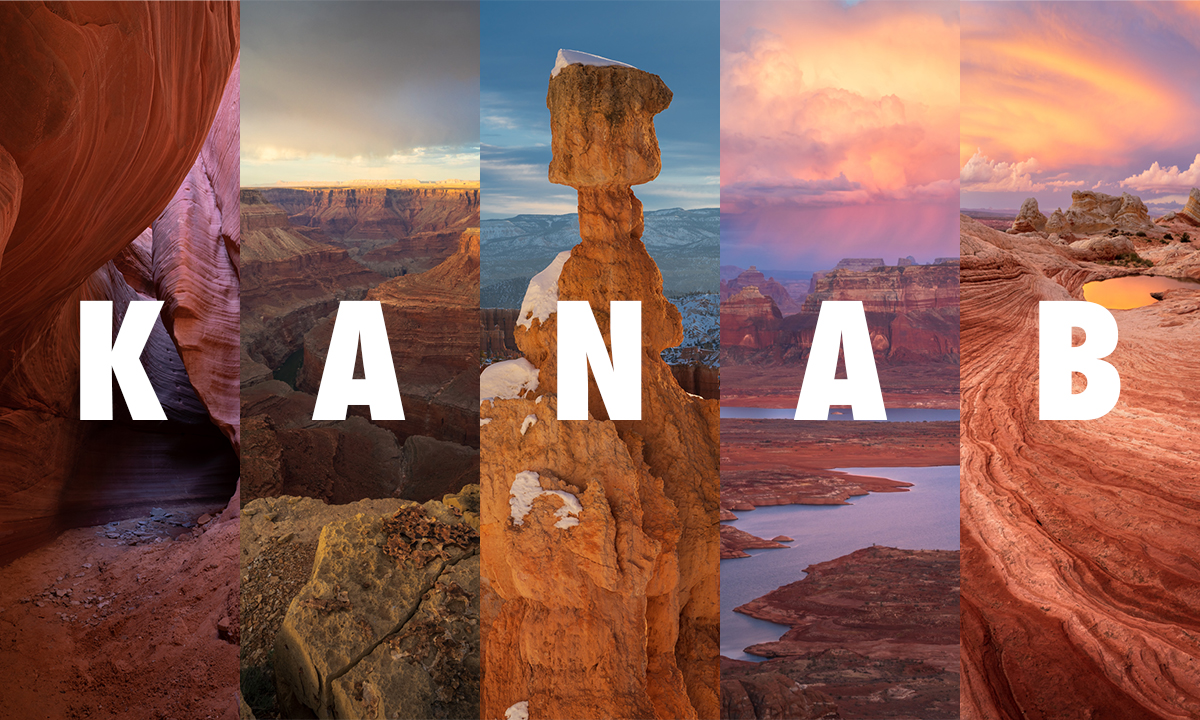
Kanab at a Glance

Located along the Utah Arizona border, Kanab is an absolute Mecca for landscape photography. Within a two hour drive, you can be at 3 different national parks, multiple national monuments, the enormous Lake Powell, dozens of slot canyons and several million acres of wilderness, ripe for exploration. In this guide, we’ll cover where, when, what to skip, and even some hidden gems.
When to Visit Kanab?
Spring (March–May)
Pros
- Comfortable temperatures for hiking
- Potential wildflowers in May
- Moderate cloud cover for sunrise / sunset
- Horizontal Milky Way photography
Cons
- Likely chance for high winds, making hiking uncomfortable and droning difficult
- Parks can be crowded
Summer (June–August)
Pros
- Monsoon season
- Incredible cloud formations & lightning photography
- Water for reflections
- Rain makes sandy roads easier
Cons
- Extreme heat
- Long distance hiking can be dangerous
- Rain makes clay roads impassable (Including the road to the Wave and Wire Pass)
Fall (September–November)
Pros
- Comfortable temperatures
- Stable weather
- Excellent hiking conditions
- Fall colors at the end of October and beginning of November
- Vertical Milky Way photography
Cons
- Parks are again crowded
- Many days of clear blue skies
Winter (December–February)
Pros
- Fewer visitors
- Occasional snow on red rock landscapes (Rare to catch this, but beautiful when it happens)
- Longer golden hour
- Cheapest hotel prices
Cons
- Chance for overcast days
- The worst season for slot canyons
- Very cold nights can make camping and hiking uncomfortable
- Milky Way season is over
- Multiple spots on the North Rim of the Grand Canyon are closed.
National Parks
Zion – 40 minutes from Kanab

Think towering sandstone walls, deep water-filled canyons, evergreen trees, and rolling slickrock terrain. Zion is a hikers dream, with some of the most dramatic scenery in the southwest.

Getting around: Access to Zion National Park is done via 3 different points. The first area is Zion Canyon. This is where you’ll find angels landing, the narrows, court of the patriarchs, and the watchman. The second is East Zion. Here you will find slick rock mountains topped with ponderosa pines, and incredible backcountry hiking to bizarre rock formations. Kolob Canyon is the last, and least visited part of Zion. The most well known attraction in Kolob is the iconic Subway, but there are many more technical canyons to photograph here.
Photography Tips
Most of the classic views (Angels Landing, Court of the Patriarchs, Canyon Overlook, Observation Point) within Zion Canyon are best photographed at sunrise. Deeper in the Narrows and other slot canyons, the towering walls block direct sunlight, creating beautiful reflected light mid-day. Sunset is better for the Watchman and Kolob Canyon section of the park.
The Narrows are best during November on clear days when you not only avoid the summer crowds, but can photograph the fall colors as well. Take the first shuttle of the day and look for the excellent reflected light conditions.
Skip the crowded Angels Landing and visit Observation Point instead. Better views and less vertical elevation gain. The parking spot is actually outside the park on East Mesa and is not suitable for sedans.
Fall and Winter will produce the best photos within the park. Both come late, with fall starting in early November, and the first snow accumulation usually happening in January. If you’re wanting to do any technical canyoneering, Spring generally has the highest water levels which make for the easiest outings.


Bryce Canyon – 90 minutes from Kanab

Bryce Canyon, the smallest of Utah’s National Parks, is often visitors favorite. Famous for its thousands of bright pink and orange hoodoos, Bryce Canyon has many miles of trails to keep a photographer busy for multiple days.

Getting around: Bryce Canyon is entirely navigable by paved road and shuttle bus, making this Utah’s easiest park to visit and photograph. The two main areas of interest from a photographic standpoint are Sunset Point and Fairyland Loop. Both offer incredibly scenic trails that take you through the heart of the park where you’ll be surrounded by hoodoos in all directions.
Photography Tips
Bryce photographs best shortly after sunrise when first light bounces around the hoodoos, causing them to glow. Wide angle compositions work great right at sunrise from the rim. Shortly after sunrise, you’ll want to switch to a telephoto lens for isolating layers and catching the incredible bounce light that makes the hoodoos glow.
As far as I’m concerned, winter is the only season to visit Bryce. The snow makes for a dramatic color contrast between the pink and orange rock. Be aware that the elevation here is around 8000 feet and mornings can frequently be below 0° Fahrenheit.
Because of its orientation, no light hits the inside of Bryce Canyon at sunset. Therefore, I consider this a rare, sunrise only location. If you’re staying in the Bryce area and want to photograph the sunset, go to shoot the nearby Kodachrome Basin State Park instead.


Grand Canyon North Rim – 95 minutes from Kanab

The Grand Canyon needs no introduction, and its north rim is more remote, 90% less crowded, and just as stunning. Visiting the north is a bit more challenging since a wildfire in 2025 took out the lodge and cabins, but while those are being rebuilt, you should absolutely take this time to experience the canyon solitude.
Getting Around: The main access point for the North Rim is via the Highway 67 to the Visitors Center. From here, you can hike and drive to several iconic viewpoints, including the crown jewel of the North Rim, Cape Royal.
Further west is the Rainbow Rim. While not as photogenic, this area offers quiet camping in a beautiful forest setting. Access here is down a long and bumpy dirt road. The best of the overlooks is Locust Point.
Further west still is the most dramatic view of the Grand Canyon, Toroweap Overlook. Here you will get a perfect view of the Colorado River, 3000 feet below you. Getting to Toroweap requires a LONG, 2.5 hour drive from Kanab, with the last couple of miles being brutal rock crawling. High clearance is mandatory. The best light at Toroweap is at sunrise, thus you’ll want to camp overnight. Permit required.
Photography Tips: Monsoon season is undoubtably the most spectacular time to visit the Grand Canyon. Lightning, fog, and the best chances for spectacular sunsets.
Because the canyon is deep, the light is often best several minutes before sunset or after sunrise.


Glen Canyon – 75 minutes from Kanab

Although not technically a national park, Glen Canyon is often referred to as Utah’s lost park. Much of the park exists on Lake Powell, a man made reservoir created by damming the Colorado River. While this allows access to this region via boat, it has also hidden many natural treasures underwater.
Glen Canyon is as difficult to access as it is beautiful. Any deep exploration takes time, but will reward you with some of the most incredible vistas, arches and canyons that exist.

Getting Around: Because of its extremely remote nature, getting around Glen Canyon requires either serious off-road driving, hiking, boating, or a mixture of all three.
A great introduction to Glen Canyon and Lake Powell is Alstrom Point, accessed via a grueling 2.5 hour off road slog. Most other points on the lake will require you to navigate by water from the Antelope Point Marina just outside of Page, AZ. The most comfortable way to do this is by renting a houseboat, but you can rent a small motorboat and camp to save money. Even a week isn’t enough to scratch the surface of Lake Powell’s 96 named canyons and 2000 mile shoreline. For the intrepid, there are many technical slot canyons to explore. My best advice for deeper exploration is to get a map, rent a boat, and start exploring.
Photography Tips
Alstrom Point and the views above Lake Powell are best at sunset, when the last light hits the buttes and mesas. April and May are my favorite months to shoot in Glen Canyon for the good for astrophotography and wildflower potential. The downside is that this time of year is often very windy. Due to the extreme temperatures and remote nature, summer visitation is not advised.


Other Natural Areas
Grand Staircase–Escalante – 10 to 60 minutes from Kanab

Perhaps the ultimate destination for adventurous landscape photographers. the Grand Staircase is easily the most diverse national monument in the country. Within its boundaries you can find dozens of slot canyons, hoodoos, arches, winding waterways, colorful badlands, and some of the most remote wilderness in the state. As a bonus, the Grand Staircase is also notable for having the darkest measurable skies in the Lower 48 states.

Getting Around: From Kanab, the access points of the Grand Staircase Escalante are found along dirt roads heading north along Highway 89. These roads allow access to sights along the southern portions of the monument such as the stunning rainbow badlands of the Paria, Cutler Point Alcove, Peek-a-Boo / Red Canyon, and the Toadstool Hoodoos. Further hiking and backpacking from these areas can lead to some incredible arches, hoodoos and bizarre rock formations. Running north from highway 89, Cottonwood Canyon Road passes the multiple arches and shallow slot canyons. This isn’t a premier destination, although it’s worth a detour if you’re in the area.
Photography Tips: In my opinion, the best time of year to visit the Grand Staircase is the fall, when temperatures have dropped and the numerous cottonwood trees begin to change color. This allows for further exploration via hiking, to access slot canyons and some of the areas more spectacular features. See my Slot Canyon 101 article for shooting canyons.


Vermilion Cliffs – 60 minutes from Kanab

You may not immediately recognize the name, but you’ve undoubttably seen photographs of the Vermillion Cliffs famous “Wave” formation. Straddling both Utah and Arizona, the Vermillion Cliffs are where you will find the most colorful and twisted sandstone on the planet.
There are many iconic sights such as the Wave, Buckskin Gulch, and White Pocket, but these represent only a fraction of the vermilion cliffs, which I still haven’t fully explored, even after 200+ visits. There are far more places here without names than with, and it doesn’t take much effort to find stunning formations which are seemingly all over. My best advice is to study apple and google maps which offer great satellite imagery. This will allow you to find plenty of amazing locations.
The best seasons to visit are spring and fall, although the summer monsoons (as long as the weather isn’t too hot) can also make for some exceptional atmospheric conditions as well as reflections. I suggest avoiding winter as the temperatures can get cold, and the lighting in many places just isn’t that great. If you visit at the end of May or beginning of June, you’ll have a good shot at photographing wildflowers which grow around the edges of any sandstone formations.

Getting around: The majority of the Vermillion Cliffs sights are accessed via House Rock Valley Road. This dirt and gravel road shouldn’t be driven without a spare tire. Any ventures further into the Vermillion Cliffs requires 4×4, good ground clearance, and a contingency plan for getting stuck in the deep sand roads. If you’re inexperienced, it’s best visited with a guide or a second vehicle.


Be aware that visiting the Wave is part of the Coyote Buttes Wilderness and requires a permit beforehand. This can be won via a lottery. Details here.
Places to Skip
The Sand Caves: A man made cave with tons of carvings. Not good for photos.
Belly of the Dragon: This is a drainage culvert. Mildly interesting, but not worth a trip.
Coral Pink Sand Dunes: The dunes themselves are always covered in vehicle tracks, and you rarely see ripples or nice patterns for good dune photography. Skip this one.
Interactive Google Map
CLICK HERE to Enjoy this interactive map to give you a better understanding of the Kanab area.
Leave a Reply